NRM Career Exploration Tool

Indigenous youth are underrepresented in Natural Resource Management careers not for lack of interest, but lack of pathways that feel like they belong to them. We built one.
Role
Lead UX/UI Designer
Duration
~20 weeks
Winter 2026
SCOPE
Lit review
Surveys
Stakeholder interviews
Usability testing
affiliations
NWIFC
NOAA
UW Information School
final design
01 — the problem
The pipeline isn't broken. It's invisible.
The current generation of NRM professionals is aging out, creating a growing gap in unfilled positions. Indigenous youth could fill it: the land connection, the cultural knowledge, the values alignment is already there, but the pathway isn't.
Existing career tools like College Bound are generic, desktop-first, and built for a broad audience. They use domain-specific language that creates cognitive barriers for youth. They show no Indigenous representation, struggle to connect the work to treaty rights, Traditional Ecological Knowledge, or the cultural context that makes NRM meaningful to these communities. They weren't built for these students, and they can feel it.
0
tools specifically designed for Indigenous youth exploring NRM careers
80%+
of current NRM professionals approaching retirement age
10
survey questions needed to generate meaningful career matches (vs. 20–25 in existing tools)
"Maybe just acknowledgement of Indigenous knowledge."
Survey respondent, reflecting on what would make NRM careers feel more relevant
DESIGN QUESTION
How might natural resource management organizations increase Indigenous youth (14-18 years old) applicants to entry-level roles so that they can increase Indigenous representation in their workforce?
02 – WHO WE DESIGNED FOR
Two people. One shared gap.
We mapped 8 stakeholder groups and narrowed our primary focus to 2. Not because the others didn't matter, but because designing for both Lola and Jeremy meant the tool would work for everyone downstream.
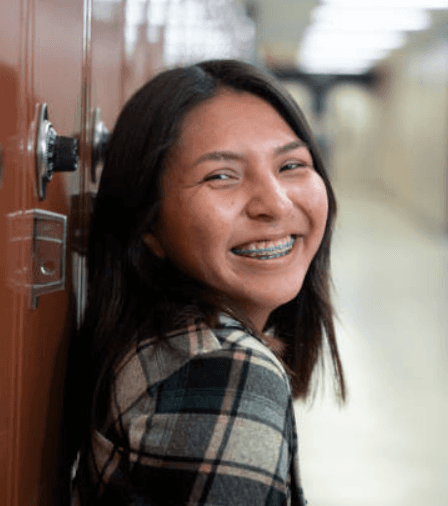
Lola
HIGH SCHOOL SENIOR | GREEN TEAM LEAD
Academically strong, deeply community-motivated. She wants a career that gives back but she doesn't know what that looks like.
Needs: a way to discover careers that connect to her values, not just her test scores.

Jeremy
COLLEGE & CAREER ADVISOR | NORTH THURSTON SCHOOLS
Uses College Bound daily and notices it fails his Indigenous students. The identities aren't well represented and the advice isnt applicable to them.
Needs: something specific he can actually put in front of them.
02 – THE RESEARCH
Three layers of evidence before we designed anything.
We ran a three-pronged research process which included: literature review, market research, and primary user research before touching Figma. The goal was to understand why existing tools fail before assuming we knew what to build.
Literature review
Career decision-making for Indigenous youth is shaped heavily by cultural values. Early exposure to nature is a key predictor of NRM interest. Culturally responsive career programs produce measurable increases in career confidence and belonging.
→ The problem isn't motivation. It's structural disconnection.
Market Research
LinkedIn, USAJobs, and Conservation Job Board use domain-specific language that creates cognitive barriers for youth. Tribal NRM sites target entry-level applicants, not explorers. MyFuture's 3-question survey outperformed longer assessments.
→ Shorter, values-framed questions outperform exhaustive assessments.
Primary Research
Surveyed Indigenous college students reflecting on high school. Interviewed 4 educators including a Natural Resources teacher, Native Student Program Specialist, Title III paraeducator, and a NOAA tribal engagement volunteer.
→ Educators want a tool for classrooms — not just self-discovery.
LITERATURE REVIEW
SYNTHESIZING WHAT'S KNOWN
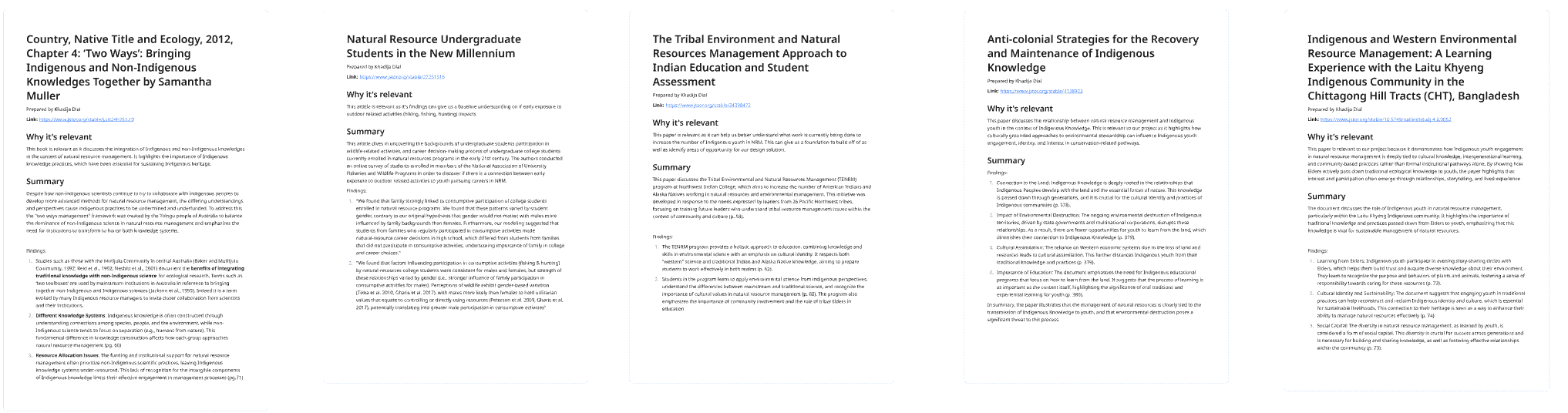
Literature review synthesis: 30+ sources mapped across cultural barriers, early exposure factors, structural inequities, and evidence for culturally responsive programs. Key finding: Indigenous youth aren't disinterested in NRM, they're disengaged by tools that erase their context.
STAKEHOLDER INTERVIEWS
4 EDUCATORS, REAL SCHOOLS
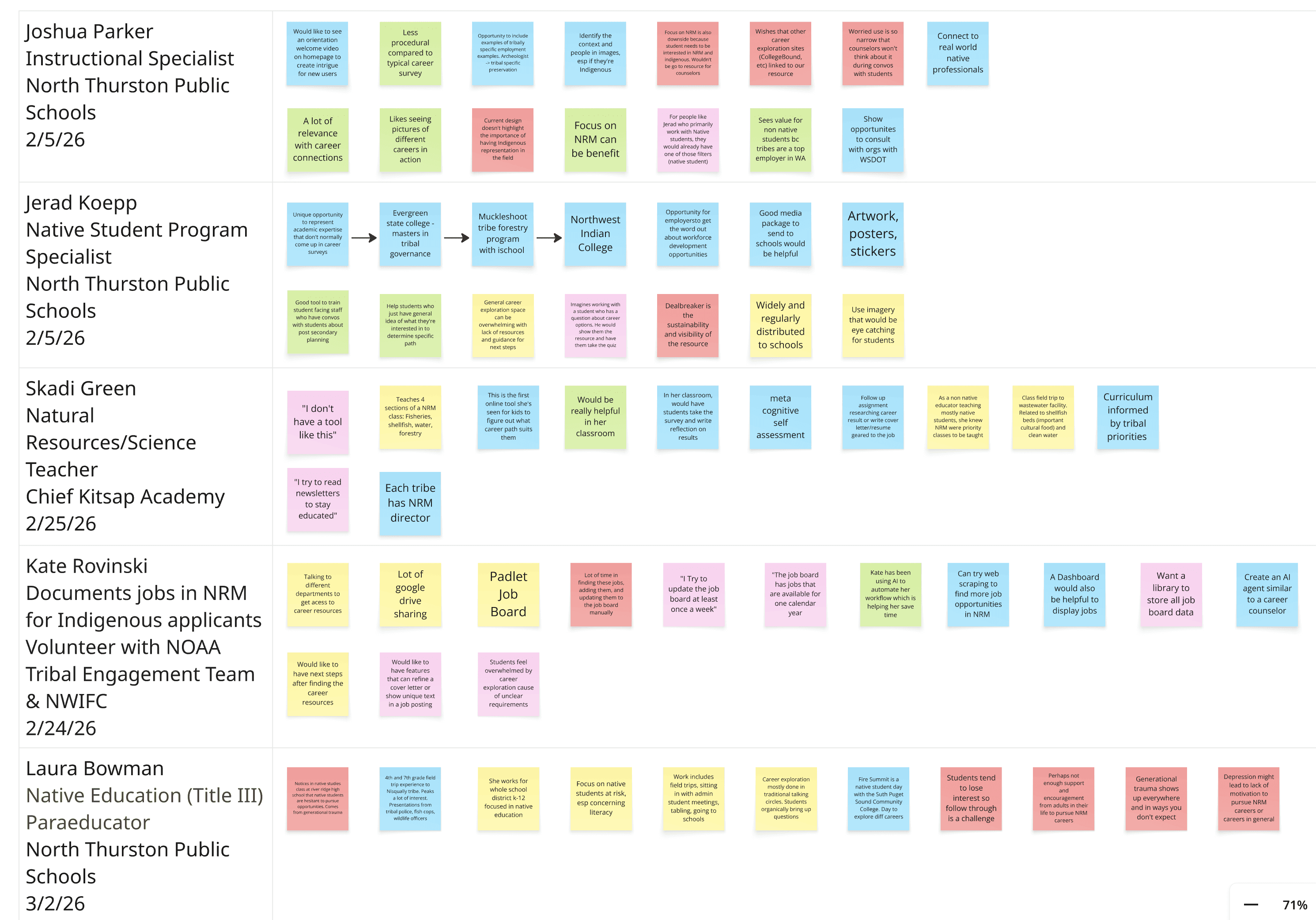
Interview synthesis across 4 educators: Joshua Parker (Instructional Specialist, North Thurston), Jerad Koepp (Native Student Program Specialist), Skadi Green (NRM/Science teacher, Chief Kitsap Academy), Kate Rovinski (NOAA Tribal Engagement volunteer). Every participant flagged representation and sustainability as critical gaps.
SURVEY NOTES
6 INDIGENOUS COLLEGE STUDENT RESPONSES
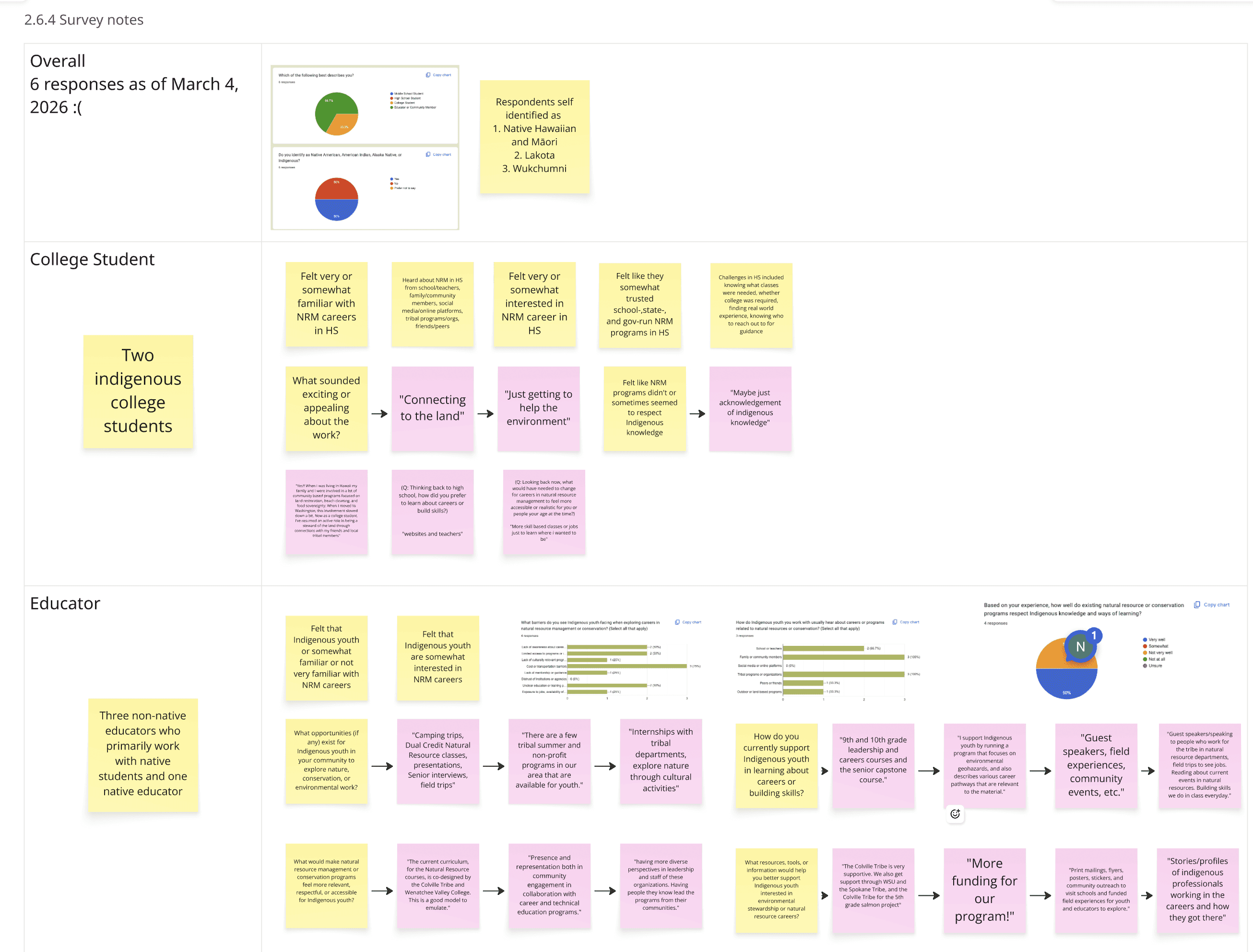
Survey respondents self-identified as Native Hawaiian and Māori, Lakota, and Wukchumni. Key patterns: NRM programs "didn't or sometimes seemed to not respect Indigenous knowledge" & the most resonant framing for the work was "connecting to the land" and "just getting to help the environment."
WHAT THE RESEARCH TOLD US TO BUILD
INSIGHT 01
Representation First
Seeing Indigenous professionals in NRM careers is a strong prerequisite for students imagining themselves there. Wanting to be able to share real stories from Indigenous people working in these fields was additionally requested by every educator we interviewed.
INSIGHT 02
Phones, Not Desktops
Indigenous youth access the internet primarily through phones. A desktop-only tool wasn't a design preference but rather an access barrier. We want to ensure students can still explore NRM careers even if it wasn't in an academic setting.
INSIGHT 03
Educators as Ditribution
Students often don't find career tools on their own. Educators need something they can use in classrooms and counseling sessions. The tool needed educator integration, not just student-facing UX.
INSIGHT 04
Culturally Sensitive
Historical distrust of government-run programs affects how Indigenous youth engage with career resources. Every design decision needed to signal community-built, not government-imposed.
"Stories/profiles of indigenous professionals working in the careers and how they got there."
Kate Rovinski, NOAA Tribal Engagement volunteer — on what would make the tool actually useful
04 – DESIGN DECISIONS
Every feature traces back to something someone said.
We ran a 2×2 prioritization exercise across impact and feasibility before touching the interface.
FEATURE PRIORITIZATION
IMPACT X FEASIBILITY MAPPING
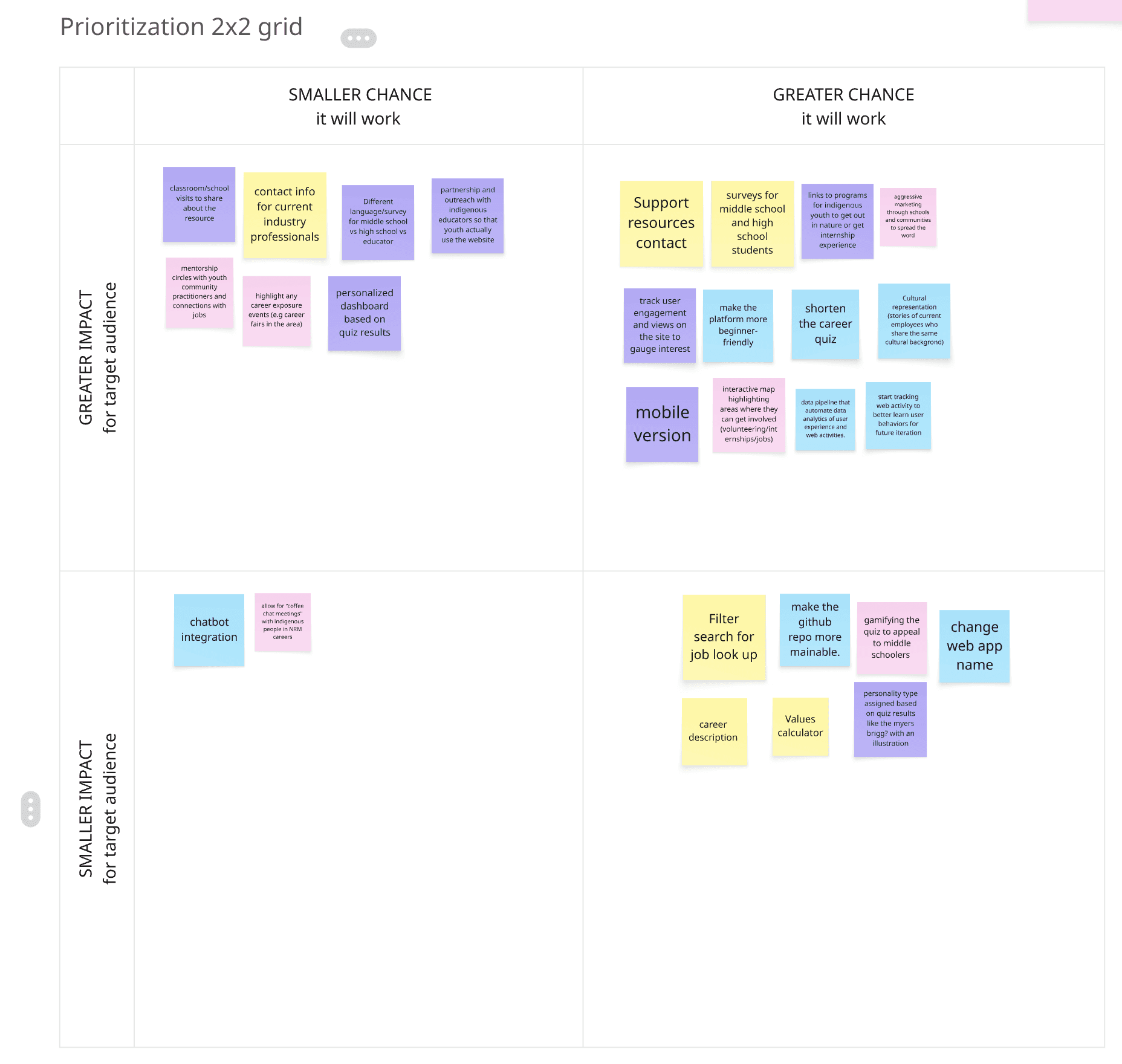
2×2 prioritization: mobile version and shortened quiz landed in the high-impact, high-feasibility quadrant. Cultural representation profiles were high-impact but required partnership work — scheduled for P1.
4 DECISIONS THAT SHAPED THE FINAL DESIGN
I
Quiz shortened from 20-25 questions to 10
Our original quiz was designed for thoroughness. But research showed that shorter, focused surveys (as few as 3 questions) are more effective for this age group. 20 questions on a phone while standing at a locker is a quiz no one finishes.
→ Research-backed: MyFuture's 3-question model outperformed exhaustive assessments.
II
Language rewritten from professional to conversational
The original tool used NRM industry terminology such as: "riparian buffer management," "tribal co-management protocols." While this is useful for professionals, it can be alienating for a 16-year-old who's never heard those words.
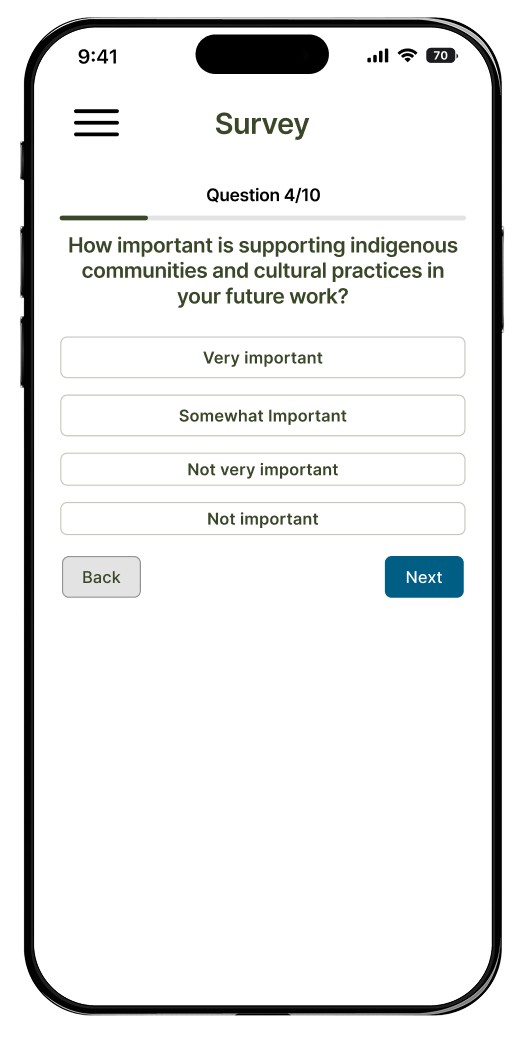
→ Every question rewritten to lead with values: "How important is supporting your community in your future work?"
II
Career cards reframed as day-in-the-life stories
Existing career databases lead with job titles, salary ranges, and required degrees. Students who've never met an NRM professional can't connect to that. We led with a narrative instead: "what does a Tuesday actually look like in this job?"
→ Showing real Indigenous professionals in real work contexts made careers feel attainable, not aspirational-but-distant.
IV
"Path to get here" diagram added to every career card
Even if a career sounds compelling, students need to see the steps from where they are now. We designed a visual pathway for each role starting from high school, making the journey legible, not just the destination.
→ Most impactful addition in concept validation: "I didn't know you could start this soon."
V
Multi-select added to quiz questions
Single-select forced false choices between values that weren't mutually exclusive. A student who cares about both wildlife and community shouldn't have to pick one. Multi-select was a direct ask from concept validation feedback.
→ Changed after user research, not after launch. That's the point of testing early.
05 – the product
What it looks like when design listens.
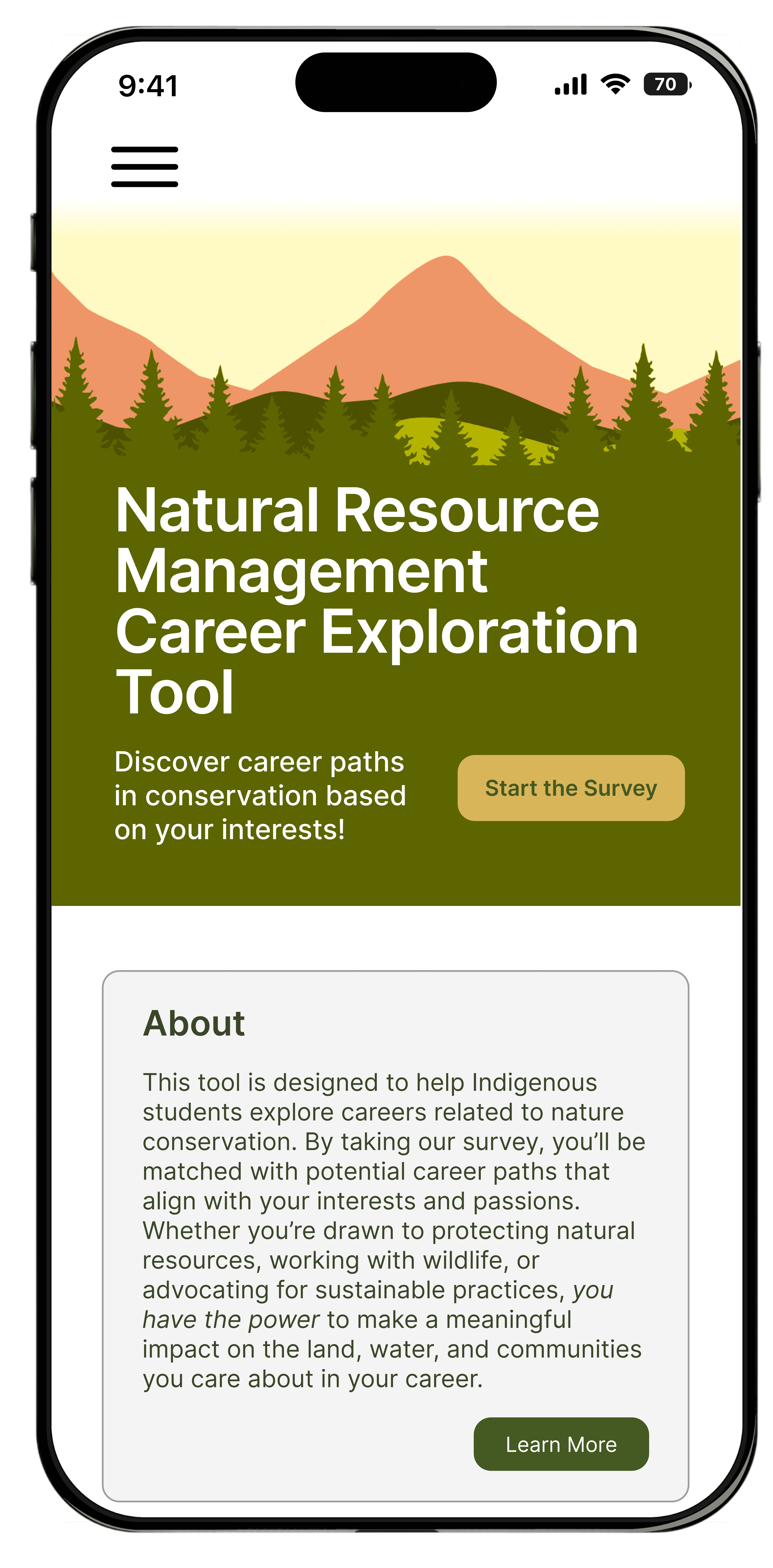
The illustrated landscape hero wasn't decorative, it was a deliberate signal. This tool belongs to the land and the people connected to it. Before a student reads a word, the visual says: this was made for you.
Home screen — the first impression
Home Screen
Illustrated PNW landscape hero. Mission-first, quiz CTA above the fold.
Quiz
Values-first questions. Progress indicator. Plain language throughout.
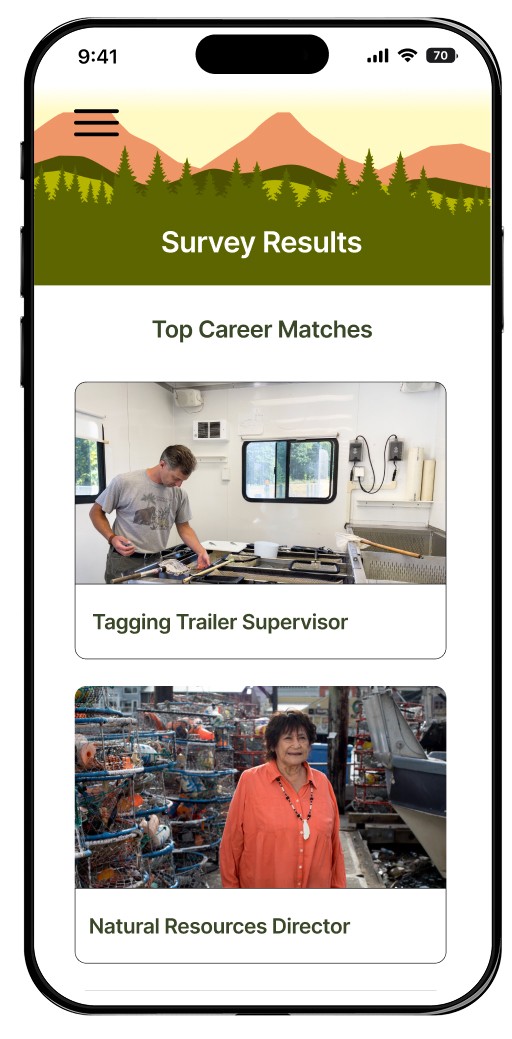
Results
Real Indigenous professionals. Real job photos. "Tagging Trailer Supervisor" not "Environmental Technician III."
Home screen — the first impression
Illustrated Landscape
PNW mountains and forest in warm earth tones, grounding the tool in the land before any words appear. This color scheme also matches NWIFC's existing branding guidelines.
Plain language mission statement
"Discover career paths in conservation based on your interests" not "natural resource management workforce development."
Single CTA: Start the Survey
No signup wall, no dropdown nav, no friction. The job of the home screen is one thing: get students into the quiz.
Results screen — careers made real
Real Indigenous professionals, real workplaces
Photos of actual people doing the work, not stock photography of generic scientists. The Natural Resources Director shown is Indigenous. That representation is the product.
Job titles in plain language
"Tagging Trailer Supervisor" instead of "Fisheries Technician Level II." Students need to be able to picture themselves in the role.
Matched by values, not aptitude
Career matches are surfaced by the student's survey responses, community orientation, land connection, interest in nature.
06 – Reflection
Designing with a community, not just for one.
This project pushed me into territory that felt genuinely important and genuinely humbling. Designing for a community that has historically been harmed by well-intentioned institutions means every design decision carries more weight than a typical product choice. The tool needs to earn trust before it earns users.
The research process, especially talking to real educators working with real Native students changed what we built in concrete, traceable ways. That's what good research does: it makes the design decisions obvious.
I