
Evaluating the Impact of Clinical Nurse Leaders

ROLE
DURATION
SKILLS / TOOLS
TEAM
CONTEXT
CNL stands for clinical nurse leader and it’s a relatively new role developed in 2003 by the American Association of Colleges of Nurses in hopes of improving the quality of patient care. Before this role was developed, there wasn't a officially established way to directly manage or improve patient care quality. A CNL plays a vital role within a healthcare team, focusing on a wide range of responsibilities.
Creating Risk Assesments
Maintaining Professional Communication
Demonstrating Strong Team Leadership
CNL Introduction
When the role and its' expectation was first introduced to nurses
Formal CNL Intervention
When nurses formally implemented the role within a hospital
SCOPE & GOALS
The main goal of my project is to discover if the implementation of the CNL role has influenced patient satisfaction scores regarding the care they received. I chose to focus on the OBGYN unit, specifically examining whether the CNL's presence has impacted patient satisfaction scores related to the survey question of effective medication communication. The effective medication communication question refers to the nurses’ ability to clearly and properly explain and clarify details of medications patients will receive.
METHODOLOGY
To understand and discover if there is a positive influence of the role on patient satisfaction scores, we need a way to compare patient satisfaction before and after the introduction to the nurses and intervention. We can do this in a variety of way yet here are 3 options I explored:
Comparing Means

A simple and effective way to assess impact, as it provides a clear measure of central tendency that is easy to interpret and communicate. It's particularly useful for identifying shifts which can help us evaluate whether observed differences are statistically significant.
Mean scores changing can be attributed to various factors unrelated to the CNL role being introduced (for example time, additional factors that are not accounted for–outlier values, or altering values in the dataset). This also only gives us a short-term insight which prevents us from making accurate long-term predictions.
Visual Plot Comparisons
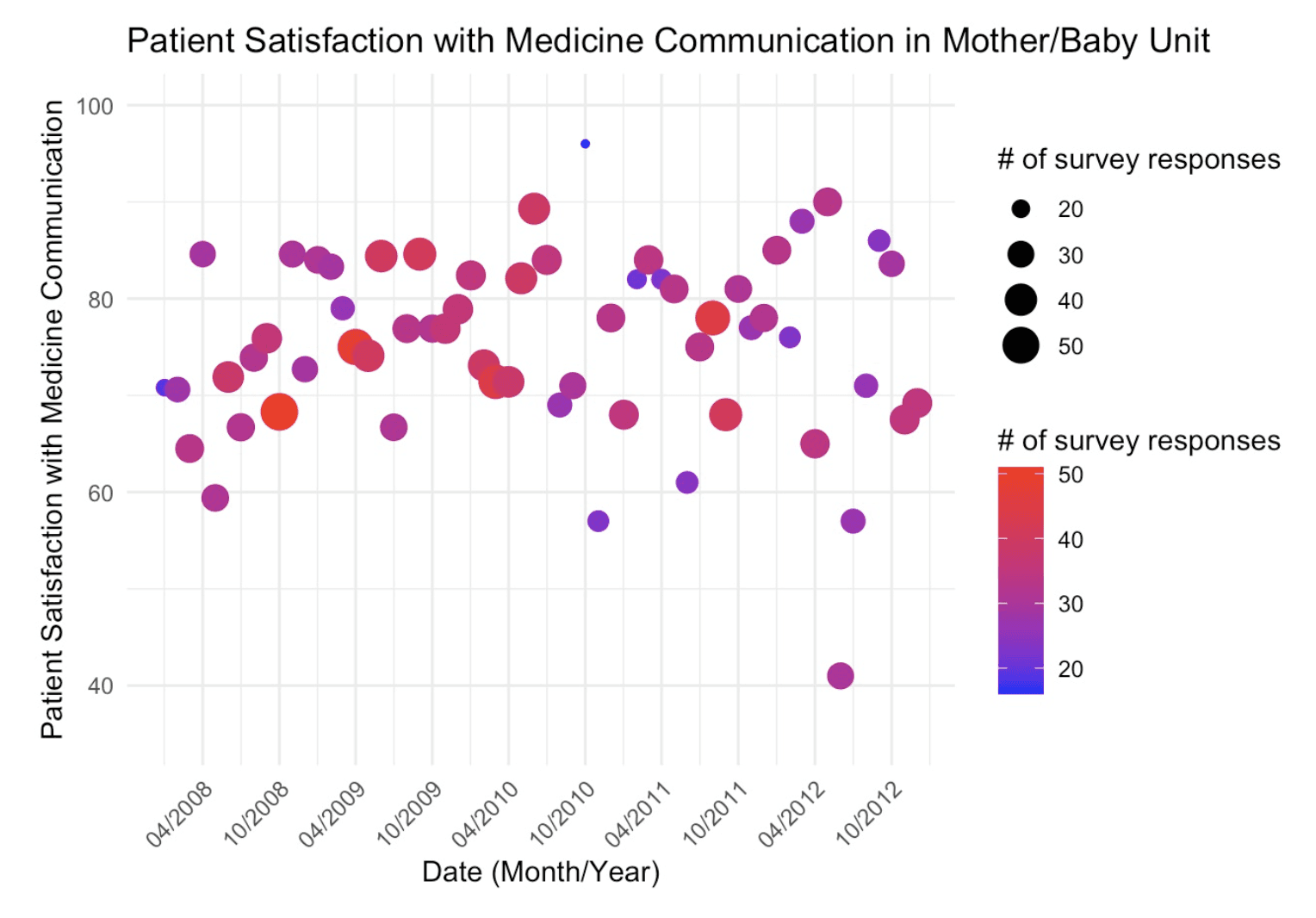
Trends and patterns can be easily observed in a visual format, making it straightforward to identify changes over time. With this method we can also analyze multiple trends on the same plot.
Interpreting visual trends can be very subjective. Each person can draw different conclusions from the same plot which can introduce a higher risk of errors. To add, visualizations alone can’t provide hard statistical evidence of significance .
Fitting a Linear Regression Model
The last way is to fit a regression line model and compare the scores between the change points. This method allows us to effectively track the change in the mean scores. Here we have the statistical equation and the ‘literal’ humane equation at the bottom.
𝐸[𝑌ₜ | 𝑡] = 𝛽₀ + 𝛽₁𝑡
𝛽₀: the true value of the outcome of interest when t=0 (or at the start of the study)
𝛽₁: the change in the outcome of interest for one unit of change in the time (the slope)
𝐸[Pt. Sat − Effective medication communication date (year−month) | date (year−month)] = 𝛽₀ + 𝛽₁ date (year−month)
Effective medication communication: the nurses’ ability to clearly and properly explain and clarify details of medications patients will receive.
Date (year-month): time metric
These two equations are basic linear equations where we have the outcome of interest being the patient satisfaction scores for effective medication communication, and time as our predictor. The significance of using 𝛽₀ and 𝛽₁ is that they measure the true value or ground truth of our outcome of interest at a specific point in time within our study.
Linear regression models can include covariates (basically additional variables) to help control for potential confounders, which can help provide a more accurate assessment of the CNL role's impact on satisfaction scores.
A potential limitation is that simple linear regression ignores that our scores are confined between 0 and 100 (since it’s a percentage) and that we are assuming that the mean scores are linear and they may not be.
Here is what the linear regression model looks like on a plot. Here I also accounted for the number of survey responses in the regression model and in the plot. To measure the impact of the cnl role’s intervention, we need to look at the change in predicted means at 2 critical points, the overall slope and the change in levels which is marked by this space in between the time change periods in both graphs.
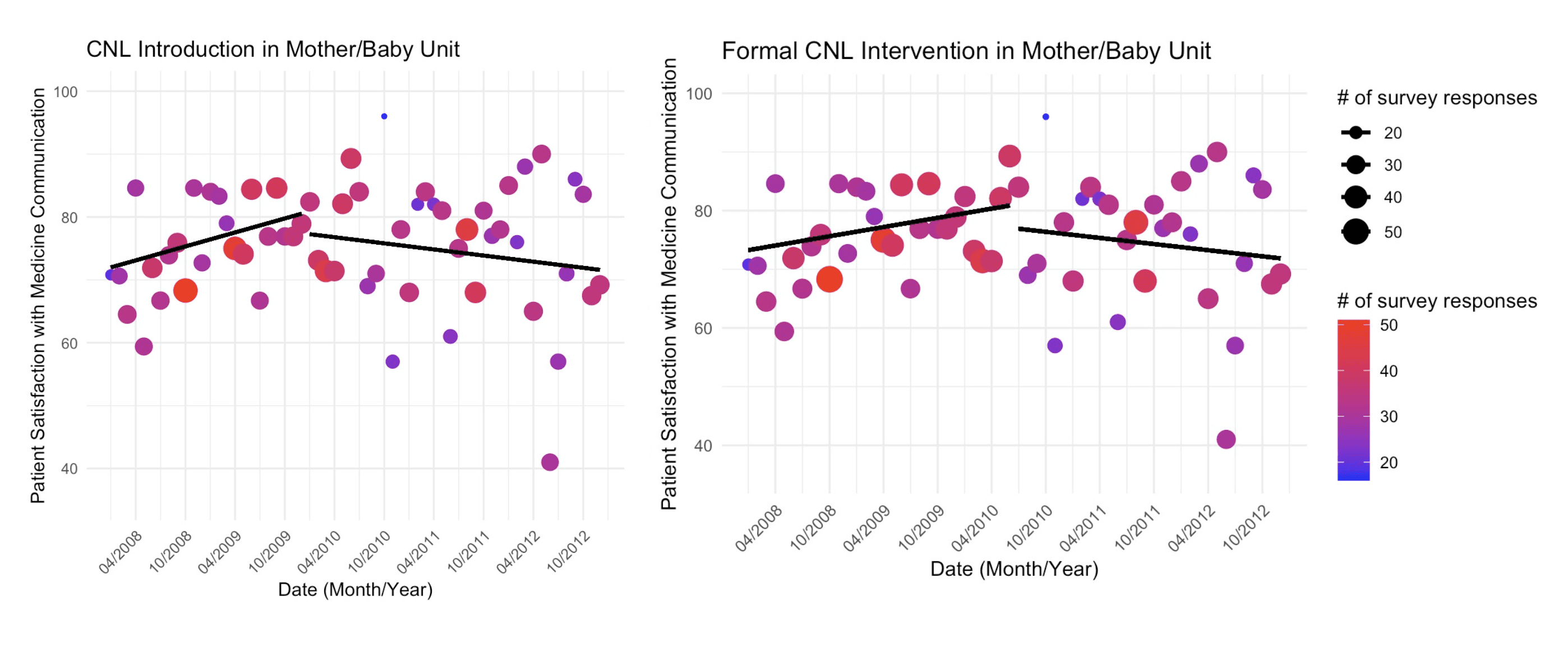
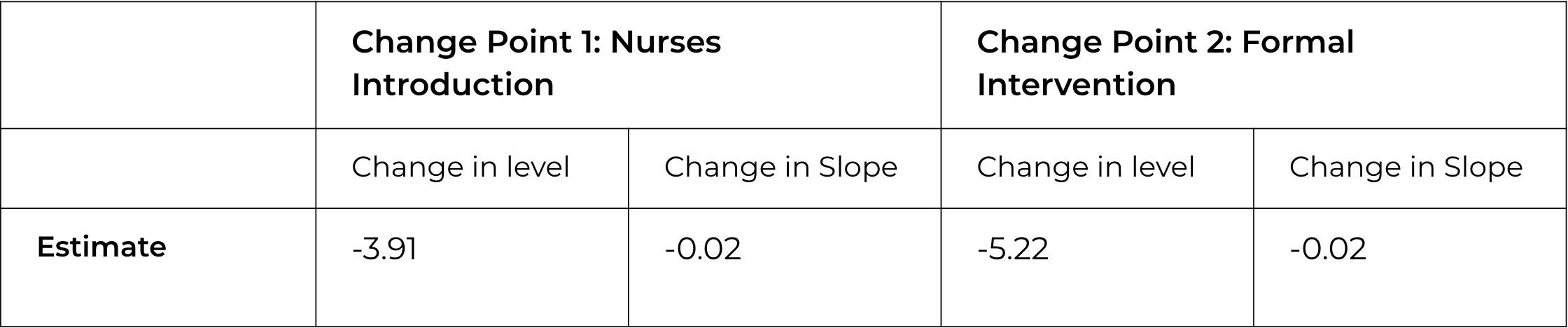
Viewing our estimated values for the change in slope, there is essentially no change in the slope which suggests that long-term, the CNL role isn’t contributing much progress in improving the quality of patient care as it is slowly declining. However, the change in levels shows a loss of 1.31 points at the time of impact.
Results
With these results, it’s hard to say that this role directly causes patient satisfaction scores to decline. This can be due to various additional factors such as:
It’s also important to note that these results are pulled only from one unit in the entire hospital. It is possible that other units could show contrasting results.
Considering patient satisfaction scores are measured on a 0-100 point scale, a long-term decline of 0.02 points and an immediate decline of 1.31 points aren’t relatively insignificant. This suggests we should now take a more holistic look at the CNL role and assess whether its design truly aligns with our goals. While the role aims to improve patient care quality, it also requires significantly more work from healthcare providers. Nurses must obtain higher levels of certification and undergo additional training, while policies and resources must be reformed and reallocated across the hospital. This can offset sentiments for not only patients, but also healthcare providers if the role isn’t defined effectively.
TAKEAWAYS
Over the course of these 3 months, I not only got to work on such an amazing project, but also learn new things about myself and challenge myself in new ways through the SeattleStatGROWS program.
Acknowledgements
Huge thanks to…
Meghan, Vinthia, Ruth, and all the people behind the scenes in coordinating and managing this SeattleStatGROWS program.
Kaiser Permanente for providing, cleaning, and make working with this data possible!
My mentor, Maricela Cruz for supporting me throughout this journey